problem framing
Problem Framing: das richtige Problem finden, bevor du nach Lösungen suchstProblem framing: find the right problem before you look for solutions
In meiner Arbeit beginnen viele teure Fehlentscheidungen bei einem Problem, das niemand geprüft hat.In my work, many expensive wrong decisions start with a problem nobody checked.
Dieser Leitfaden erklärt, was Problem Framing ist, wann es sich lohnt und wie du in fünf Schritten zu einem Problemsatz kommst, der trägt. Er zeigt die Problem Framing Map der Strategyzer AG, vier Reifegrade und die Grenzen der Methode. Elf Unterseiten vertiefen jeden Teil.This guide explains what problem framing is, when it pays off and how you get to a problem statement that holds in five steps. It shows the Problem Framing Map by Strategyzer AG, four maturity levels and the limits of the method. Eleven subpages go deeper into each part.

Was du mitnimmstWhat you will take away
- Problem Framing ist die Klärung, welches Problem du löst, bevor du Lösungen suchst.Problem framing is clarifying which problem you are solving before you look for solutions.
- In einer HBR-Umfrage von 2017 unter 106 Führungskräften aus 91 Unternehmen in 17 Ländern, Selbstauskunft, sagten 85 Prozent, ihre Organisation sei schlecht darin, Probleme zu diagnostizieren.In a 2017 HBR survey of 106 executives from 91 companies in 17 countries, self-reported, 85 percent said their organisation is poor at diagnosing problems.
- Das Problem ist die Lücke zwischen heutigem und gewünschtem Zustand. Ohne gewünschten Zustand gibt es kein Problem, nur eine Beobachtung.The problem is the gap between the current and the desired state. Without a desired state there is no problem, only an observation.
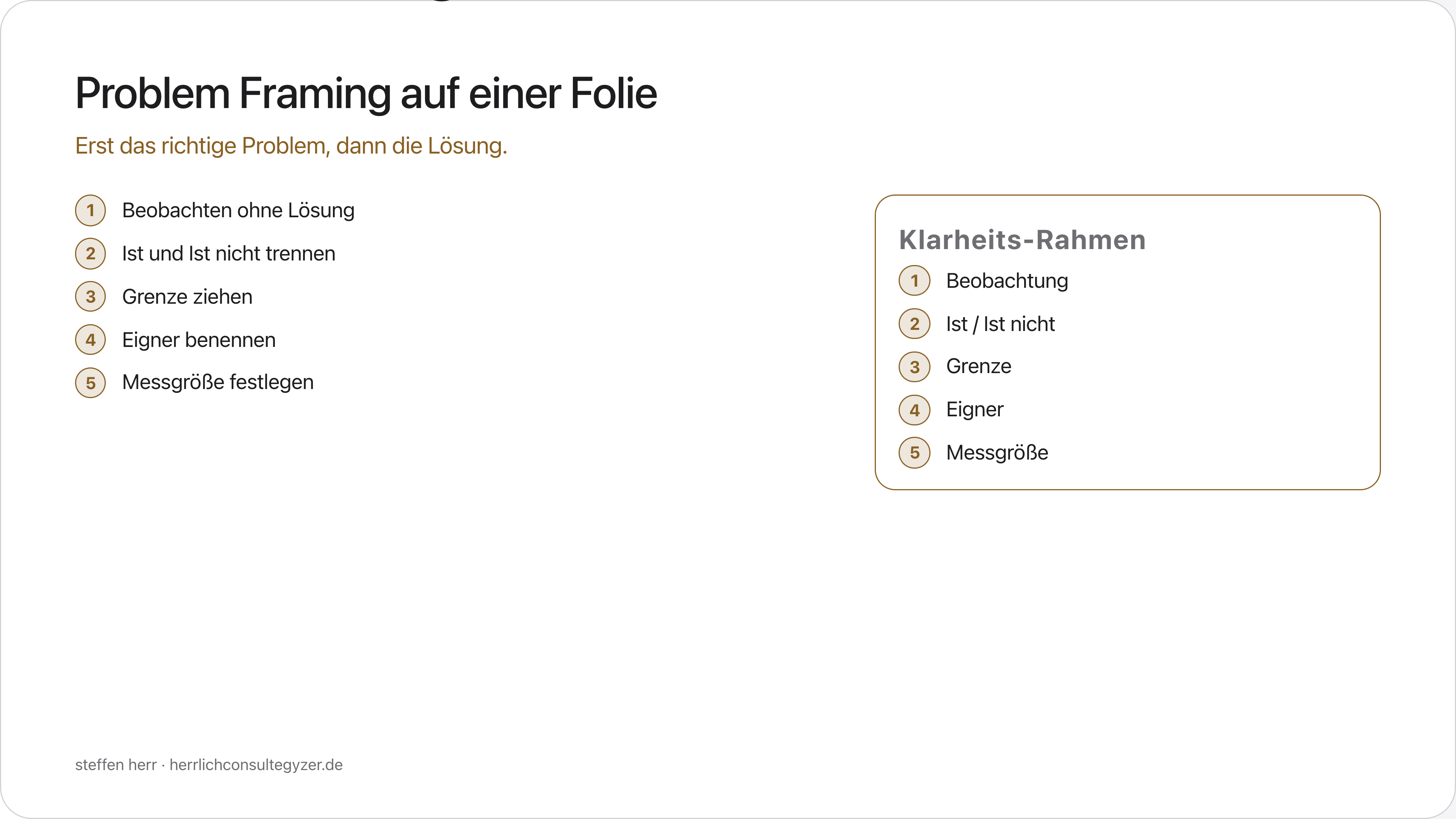
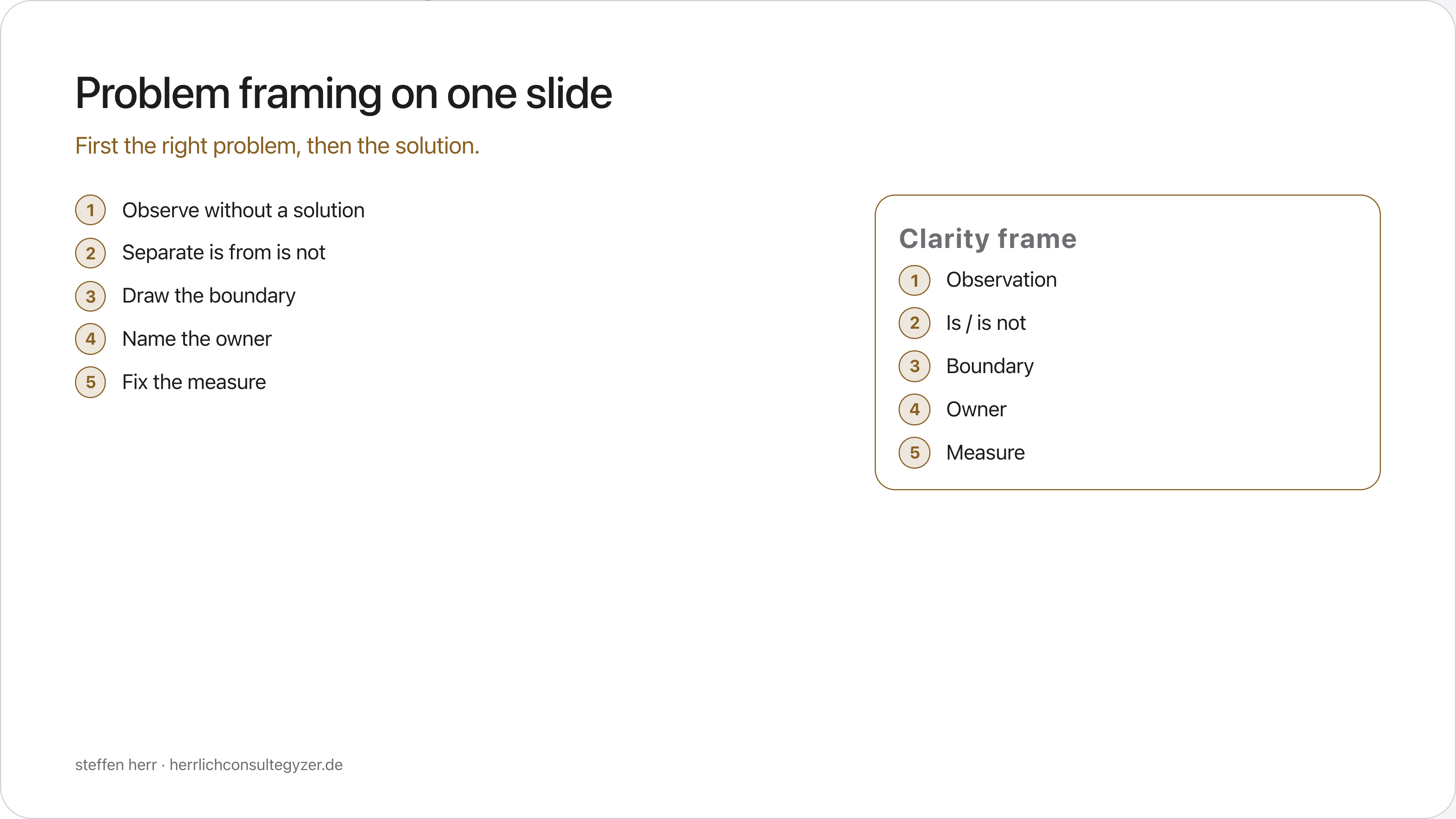
- Fünf Schritte führen zum Problemsatz: beobachten, Ist und Ist nicht trennen, eingrenzen, Eigner benennen, Messgröße festlegen.Five steps lead to the problem statement: observe, separate is from is not, set a boundary, name the owner, fix a measure.
- Die Problem Framing Map der Strategyzer AG (Osterwalder, Bostelaar, Viki) hat sechs Felder und kein Problemfeld, weil das Problem die Lücke zu den Desired Outcomes ist.The Problem Framing Map by Strategyzer AG (Osterwalder, Bostelaar, Viki) has six fields and no problem field, because the problem is the gap to the desired outcomes.
- In der Krise gilt: erst handeln, die Lage stabilisieren, dann rahmen. Problem Framing setzt voraus, dass du gemeinsam denken kannst.In a crisis: act first, stabilise the situation, then frame. Problem framing assumes you have enough stability to think together.
- Der Rahmen des Problems bestimmt, wohin Aufmerksamkeit fließt. Eine andere Rahmung kann eine andere Maßnahme sichtbar machen, noch bevor die erste Idee entsteht.The frame of the problem determines where attention flows. A different frame can make a different measure visible before the first idea arises.
- Das 5E-Framework (Engage, Evaluate, Explore, Expand, Execute) ordnet Problem Framing als zweiten Schritt in eine strukturierte Gestaltungsarbeit ein.The 5E Framework (Engage, Evaluate, Explore, Expand, Execute) positions problem framing as the second step in structured design work.
Stand: 19. November 2026 · Steffen HerrUpdated: 19 November 2026 · Steffen Herr
Das Werkzeug im MittelpunktThe tool at the centre
Die Problem Framing Map.The Problem Framing Map.
Sechs Felder, kein Feld namens Problem: Das Problem ist die Lücke zwischen dem, was heute ist, und dem, was die Beteiligten erreichen wollen. Die Idee stammt von der Strategyzer AG. Ich zeige die Map in eigener Gestaltung und erkläre sie Feld für Feld.Six fields and no field called problem: the problem is the gap between what is today and what the people involved want to achieve. The idea comes from Strategyzer AG. I show the map in my own design and explain it field by field.
LeitfadenGuide
Das ganze Thema in elf Kapiteln.The whole topic in eleven chapters.
Diese elf Kapitel vertiefen den Leitfaden. Der Selbstcheck zeigt sofort, wo dein Problemsatz schwächelt. Problemdefinition erklärt alle fünf Schritte mit Beispielen. Problem Statement formulieren übt den Prüfsatz. Symptom oder Ursache vertieft das Eisberg-Modell. Die Reframing-Methode zeigt, wie du eine Rahmung gezielt angreifst. Die Problem Framing Map führt in das Werkzeug der Strategyzer AG ein. Der Methodenvergleich ordnet sieben Ansätze nebeneinander. Die Mittelstandsseite rechnet typische Muster durch. Die Vorlage ist zum direkten Ausfüllen. Der Workshop gibt dir Rollen und Ablauf. Der Selbstcheck wertet deine Eingabe aus und nennt den schwächsten Punkt.These eleven chapters go deeper into the guide. The self-check shows straight away where your problem statement is weak. Problem definition explains all five steps with examples. Problem statement writing practises the check sentence. Symptom or cause goes deeper into the iceberg model. The reframing method shows how to challenge a frame deliberately. The Problem Framing Map introduces the Strategyzer AG tool. The method comparison lines up seven approaches. The mid-sized companies page works through typical patterns. The template is ready to fill in. The workshop page gives you roles and process. The self-check evaluates your input and names the weakest point.
Framing oder Lösung?Framing or solving?
Problem Framing klärt, welches Problem gelöst wird, Problemlösung klärt, wie. Der Unterschied entscheidet über Budget und Tempo.Problem framing decides which problem gets solved, problem solving decides how. The difference determines budget and speed.
Kapitel lesenRead chapterProblemdefinitionProblem definition
Fünf Schritte vom diffusen Ärger zum Problemsatz: beobachten, vergleichen, eingrenzen, Eigner klären, messen.Five steps from vague annoyance to a problem statement: observe, compare, bound, clarify the owner, measure.
Kapitel lesenRead chapterProblem StatementProblem statement
Der Prüfsatz fasst Eigner, Beobachtung, Ist und Ist nicht, Messgröße und Grenze in einem Satz zusammen. Mit Vorlage, Beispielen und Test.The check sentence combines owner, observation, is and is not, measure and boundary in one sentence. With template, examples and test.
Kapitel lesenRead chapterSymptom oder Ursache?Symptom or cause?
5 Why, Ishikawa, Ist/Ist nicht und Problembaum im Vergleich: Stärken, Grenzen und eine Auswahlhilfe.5 Why, Ishikawa, is/is not and issue tree compared: strengths, limits and a selection aid.
Kapitel lesenRead chapterReframingReframing
Reframing prüft in drei Schritten, ob ein besseres Problem zu lösen ist: Frame, Reframe, Move forward. Mit sieben Praktiken und Fragen für Teams.Reframing tests in three steps whether a better problem can be solved: frame, reframe, move forward. With seven practices and questions for teams.
Kapitel lesenRead chapterProblem Framing MapProblem Framing Map
Die Problem Framing Map strukturiert Probleme in sechs Feldern ohne ein Feld namens Problem, weil Problem die Lücke zwischen heutiger Realität und gewünschten Ergebnissen ist.The Problem Framing Map structures problems in six fields without a field called problem, because problem is the gap between current reality and desired outcomes.
Kapitel lesenRead chapterWie-können-wir-FragenHow Might We questions
Eine Wie-können-wir-Frage macht aus einer Beobachtung eine offene, gemeinsame und handlungsnahe Arbeitsfrage.A How Might We question turns an observation into an open, shared and actionable working question.
Kapitel lesenRead chapterMethoden im VergleichMethods compared
Die Methoden unterscheiden sich darin, ob sie Rahmen setzen, Ursachen suchen oder den Problemtyp bestimmen.The methods differ in whether they set the frame, search for causes or determine the type of problem.
Kapitel lesenRead chapterWorkshopWorkshop
Ein Problem-Framing-Workshop führt eine Gruppe in 60 bis 180 Minuten von mehreren Meinungen zu einem Prüfsatz mit Eigner, Messgröße und Frist.A problem framing workshop takes a group in 60 to 180 minutes from several opinions to one check sentence with owner, measure and deadline.
Kapitel lesenRead chapterVorlageTemplate
Der Klarheits-Rahmen führt dich in fünf Feldern zu einem Prüfsatz, in dem Eigner, Beobachtung, Messgröße und Grenze stehen.The Klarheits-Rahmen takes you through five fields to a check sentence naming owner, observation, measure and boundary.
Kapitel lesenRead chapterProblem Framing im MittelstandProblem framing in mid-sized companies
Fünf Fehlrahmungen kehren im Mittelstand oft wieder: Lösung als Problem, Symptom, zu groß, falscher Eigner und Ziel ohne Messgröße.Five misframings often return in mid-sized companies: solution as problem, symptom, too big, wrong owner and goal without a measure.
Kapitel lesenRead chapterDas 5E-FrameworkThe 5E Framework
Fünf Phasen, die zeigen, wo im Prozess Problem Framing aufhört und Problemlösung beginnt.Five phases that show where in the process problem framing ends and problem solving begins.
Kapitel lesenRead chapterPerspektiven und AnnahmenPerspectives and assumptions
Perspektiven bestimmen, was als Problem gilt. Annahmen bestimmen, was als Lösung gilt. Beides muss explizit werden.Perspectives determine what counts as a problem. Assumptions determine what counts as a solution. Both must become explicit.
Kapitel lesenRead chapterOpportunity StatementsOpportunity statements
Opportunity Statements öffnen den Lösungsraum. Vier Kriterien unterscheiden gute von schlechten Formulierungen.Opportunity statements open the solution space. Four criteria distinguish good from poor formulations.
Kapitel lesenRead chapterSystemdenkenSystems thinking
Das Eisberg-Modell, das Cynefin-Framework und einfache Feedbackschleifen helfen, die Tiefenstruktur eines Problems zu erkennen.The iceberg model, the Cynefin framework and simple feedback loops help recognise the deep structure of a problem.
Kapitel lesenRead chapter
DefinitionDefinition
Was ist Problem Framing?What is problem framing?
Problem Framing ist die Klärung, welches Problem ein Team löst, bevor es nach Lösungen sucht. Es legt fest, für wen das Problem besteht, was genau schiefläuft, woran du Erfolg erkennst und was bewusst nicht dazugehört, damit am Ende nicht die falsche Frage beantwortet wird.Problem framing is the clarification of which problem a team is solving before it looks for solutions. It settles who has the problem, what exactly is going wrong, how you will recognise success and what deliberately does not belong to it, so that in the end the wrong question does not get answered.
Im Deutschen sagen manche Problemrahmung, andere Problemdefinition oder Problemstellung. Ich benutze Problem Framing für den ganzen Weg und Problemdefinition für sein Ergebnis. Reframing meint den Teil, in dem du eine Rahmung bewusst angreifst und eine bessere suchst.In German you will find Problemrahmung, Problemdefinition and Problemstellung used side by side. I use problem framing for the whole path and problem definition for its result. Reframing is the part where you deliberately challenge a frame and look for a better one.
Abgrenzung: Problemlösung beginnt, wenn der Problemsatz steht. Wer beide vermischt, diskutiert Lösungen für ein Problem, das jeder anders versteht.The boundary: problem solving starts once the problem statement stands. Anyone who mixes the two ends up debating solutions for a problem everyone understands differently.
Meine HaltungMy position
Warum ich Rahmen vor Lösung stelleWhy I put framing before the solution
Ich arbeite mit mittelständischen Führungskräften, die Erfahrung haben und unter Zeitdruck entscheiden. Viele tragen Jahrzehnte Branchenwissen. Das ist kein Nachteil. Es wird zum Nachteil, wenn die erste Reaktion auf ein neues Problem in einer bekannten Lösung landet, noch bevor das Problem beschrieben ist.I work with mid-sized company executives who have experience and decide under time pressure. Many carry decades of industry knowledge. That is not a disadvantage. It becomes one when the first reaction to a new problem lands in a familiar solution before the problem is described.
Ich entscheide selbst schnell, wenn der Kontext klar ist: Schritt klein, Wirkung begrenzt, Rücknahme möglich. Dann kostet das Framing mehr als der Fehler. In diesen Fällen handle ich direkt und prüfe nach. Meine Grenze liegt dort, wo die Entscheidung teuer, die Betroffenen viele oder die Rücknahme aufwendig ist.I decide quickly myself when the context is clear: step small, effect limited, reversal possible. Then framing costs more than the mistake. In those cases I act directly and check afterwards. My line sits where the decision is expensive, many people are affected or reversal is costly.
Problem Framing ist für mich kein Ritual und keine Methode, die Entscheidungen verlangsamt. Es ist der Moment, in dem ich nachfrage, ob das Richtige gelöst wird, bevor Zeit und Geld fließen.Problem framing is not a ritual for me, and not a method that slows decisions. It is the moment I check whether the right thing is being solved before time and money flow.
WarumWhy
Warum lohnt es sich, das Problem zuerst zu klären?Why is it worth clarifying the problem first?
Weil eine Lösung nur so gut ist wie das Problem, auf das sie antwortet. Thomas Wedell-Wedellsborg befragte für die Harvard Business Review 106 Führungskräfte aus 91 Unternehmen in 17 Ländern: 85 Prozent stimmten zu, dass ihre Organisation schlecht darin ist, Probleme zu diagnostizieren, und 87 Prozent, dass das erhebliche Kosten verursacht. Selbstauskunft einer kleinen Stichprobe, keine repräsentative Studie.Because a solution is only as good as the problem it answers. For the Harvard Business Review, Thomas Wedell-Wedellsborg surveyed 106 executives from 91 companies in 17 countries: 85 percent agreed that their organisation is poor at diagnosing problems, and 87 percent that this causes significant costs. Self-reported data from a small sample, not a representative study.
Das Muster kennst du vermutlich aus eigener Erfahrung: ein Projekt läuft, kostet und endet mit dem Befund, dass das eigentliche Problem ein anderes war.You probably know the pattern from your own experience: a project runs, costs money and ends with the finding that the actual problem was a different one.
85%
stimmen zu: Die eigene Organisation ist schlecht darin, Probleme zu diagnostizieren.agree: their own organisation is bad at diagnosing problems.
87%
stimmen zu: Dieser Mangel verursacht hohe Kosten.agree: this flaw carries high costs.
Quelle: Wedell-Wedellsborg, Harvard Business Review 2017, hbr.org/2017/01/are-you-solving-the-right-problems. Stichprobe: 106 Führungskräfte aus 91 Unternehmen in 17 Ländern, Selbstauskunft.Source: Wedell-Wedellsborg, Harvard Business Review 2017, hbr.org/2017/01/are-you-solving-the-right-problems. Sample: 106 executives from 91 companies in 17 countries, self-reported.
EntscheidungDecision
Wann lohnt sich Problem Framing?When is problem framing worth it?
Es lohnt sich, wenn mindestens eines davon zutrifft: Die Ursache ist umstritten, mehrere Menschen oder Bereiche sind betroffen, oder die Lösung wäre teuer und schwer rückholbar. Wenn die Ursache bekannt ist und der Schritt klein und umkehrbar, kannst du direkt handeln und später prüfen.It is worth it when at least one of these applies: the cause is disputed, several people or departments are affected, or the solution would be expensive and hard to undo. If the cause is known and the step is small and reversible, you can act right away and check afterwards.
Lösung klar und unstrittig?Solution clear and undisputed?
Ja: direkt umsetzen.Yes: implement directly.
Fehlgriff teurer als ein Tag Klärung?Wrong move costlier than a day of clarification?
Nein: kurz rahmen (60 Min).No: frame briefly (60 min).
Mehrere Bereiche betroffen?Several areas affected?
Ja: gründlich rahmen (Workshop).Yes: frame thoroughly (workshop).
Eine Sonderfrage ist der Problemtyp. Bei komplexen Lagen, in denen Ursache und Wirkung erst im Nachhinein erkennbar sind, hilft keine Analyse am Schreibtisch. Dort rahmst du klein, probierst und rahmst neu. Die Unterseite zu den Methoden ordnet das mit Cynefin ein.A special case is the type of problem. In complex situations where cause and effect only become visible in hindsight, no analysis at the desk helps. There you frame small, try something and frame again. The methods subpage sorts this out with Cynefin.
Das ProblemThe problem
Das Problem ist die LückeThe problem is the gap
Ein Problem existiert, wenn ein heutiger Zustand von einem gewünschten Zustand abweicht und jemand diese Abweichung schließen will. Ohne gewünschten Zustand gibt es kein Problem, sondern eine Beobachtung. Ohne heutigen Zustand fehlt der Bezugspunkt. Die Lücke zwischen beiden ist das Problem.A problem exists when a current state deviates from a desired state and someone wants to close that gap. Without a desired state there is no problem, only an observation. Without a current state the reference point is missing. The gap between the two is the problem.
Diese Unterscheidung klingt einfach und wird oft übersprungen. Wenn jemand sagt „Wir haben ein Problem mit dem Vertrieb“, beschreibt er meist ein Unbehagen, selten die Lücke. Wer sofort nach der Lösung fragt, überspringt die Frage, was das Problem überhaupt ist.This distinction sounds simple and is often skipped. When someone says we have a problem with sales, they usually describe a discomfort, rarely the gap. Anyone who immediately asks for the solution skips the question of what the problem actually is.
Für das Framing bedeutet das: Du brauchst beide Seiten. Der heutige Zustand ist beschreibbar durch Beobachtung und Ist-Ist-nicht-Vergleich. Der gewünschte Zustand ist das, was die Strategyzer AG Desired Outcome nennt und was ich als Messgröße im Prüfsatz festhalte.For framing this means you need both sides. The current state is describable through observation and an is-is-not comparison. The desired state is what Strategyzer AG calls the desired outcome and what I fix as the measure in the check sentence.
EbenenLevels
Symptom oder Ursache?Symptom or cause?
Was du siehst, ist das Symptom: steigende Fehlzeiten, sinkende Marge, Beschwerden aus dem Vertrieb. Was es erzeugt, liegt tiefer. Das Eisberg-Modell aus der Systemtheorie zeigt, warum du auf der Oberfläche intervenierst und das Problem auf der unteren Ebene bleibt: Muster, Strukturen und mentale Modelle bleiben unsichtbar, wenn du nur auf Ereignisse reagierst.What you see is the symptom: rising absenteeism, falling margins, complaints from sales. What produces it lies deeper. The iceberg model from systems thinking shows why you intervene at the surface and the problem stays at the lower level: patterns, structures and mental models remain invisible when you only react to events.
In meiner Arbeit lautet die Frage nicht „Was ist das eigentliche Problem?“, als gäbe es eine einzig richtige Tiefe. Die Frage lautet: Auf welcher Ebene willst du eingreifen, um mit dem geringsten Aufwand die größte Wirkung zu erzielen? Das ist ein Urteil, das im Prüfsatz festgehalten werden sollte.In my work the question is not what is the real problem, as though there were one correct depth. The question is at which level you want to intervene to achieve the greatest effect with the least effort. That is a judgement that belongs in the check sentence.
Symptom oder Ursache?Symptom or cause?
Das Eisberg-Modell in der Praxis: wie du entscheidest, auf welcher Ebene du eingreifst.The iceberg model in practice: how to decide at which level you intervene.
Zur UnterseiteTo the subpage
AblaufProcess
Wie läuft Problem Framing in fünf Schritten ab?How does problem framing work in five steps?
Du beobachtest ohne Lösung, trennst Ist und Ist nicht, ziehst eine Grenze, benennst den Eigner und legst eine Messgröße fest. Das Ergebnis ist ein einziger Problemsatz, den jede beteiligte Person gleich versteht und der sich in 90 Tagen prüfen lässt. Die Unterseite zur Problemdefinition führt jeden Schritt aus.You observe without a solution, separate is from is not, draw a boundary, name the owner and fix a measure. The result is one problem statement that everyone involved understands the same way and that can be checked in 90 days. The problem definition subpage walks through each step.
- Beobachte, was passiert, ohne eine Lösung zu nennen.Observe what is happening without naming a solution.
- Trenne, wo es auftritt und wo vergleichbar nicht.Separate where it occurs from where, in a comparable place, it does not.
- Ziehe die Grenze: Was gehört dazu, was ausdrücklich nicht?Draw the boundary: what belongs to it, what explicitly does not?
- Benenne den Eigner: Wer hat das Problem, wer entscheidet?Name the owner: who has the problem, who decides?
- Lege die Messgröße fest, an der du in 90 Tagen siehst, dass es kleiner ist.Fix the measure that shows in 90 days that the problem has become smaller.
Anlass sammelnCollect the trigger
Was hat den Anlass geliefert, wer hat ihn gemeldet?What triggered this, and who reported it?
Beobachtung ohne LösungObservation without a solution
Nur beschreiben, was passiert.Describe only what happens. No “we need”.
Ist, Ist nicht und GrenzeIs, is not and boundary
Wo zeigt es sich, wo nicht, was gehört dazu?Where does it show, where not, what belongs?
Eigner und MessgrößeOwner and measure
Wer hat das Problem, woran siehst du Fortschritt?Who has the problem, how will you see progress?
Prüfsatz testenTest the check sentence
Satz laut lesen und von Beteiligten gegenlesen lassen.Read aloud and let those involved review it.
Typisches MusterTypical pattern
Von „Uns fehlen Fachkräfte“ zum PrüfsatzFrom 'We lack skilled staff' to the check sentence
Im Mittelstand fallen Entscheidungen schnell und werden selten hinterfragt. Führungskräfte haben viel Erfahrung und wenig Zeit. Das ist eine Stärke, solange das Problem stimmt. Stimmt es nicht, steht die falsche Lösung schnell im Betrieb, bezahlt und gewollt.In mid-sized companies decisions are made quickly and rarely questioned. Executives have a lot of experience and little time. That is a strength as long as the problem is right. If it is not, the wrong solution is quickly in operation, paid for and wanted.
Dieser Durchlauf zeigt, wie ein typischer Satz aus der Praxis in einen tragfähigen Prüfsatz wird. Jeder Schritt prüft eine Fehlrahmung.This run-through shows how a typical sentence from practice becomes a sturdy check sentence. Each step tests one misframing.
- Ausgangssatz: „Uns fehlen Fachkräfte in der Montage.“ Dieser Satz enthält die versteckte Lösung „einstellen“ und nennt kein Problem.Starting sentence: 'We lack skilled staff in production.' This sentence contains the hidden solution 'hire' and names no problem.
- Ohne Lösung: Was beobachtest du konkret? Linie 3, Spätschicht, seit drei Monaten zwei Stellen unbesetzt, Rüstzeiten steigen über 45 Minuten.Without a solution: what do you observe specifically? Line 3, late shift, two positions open for three months, set-up times rising above 45 minutes.
- Ist / Ist nicht: Wo tritt es auf, wo unter vergleichbaren Bedingungen nicht? Spätschicht Linie 3 betroffen, Frühschicht und Linie 2 laufen normal.Is / is not: where does it occur, and where, under comparable conditions, does it not? Late shift line 3 affected, early shift and line 2 running normally.
- Grenze: Betroffen ist die Spätschicht Linie 3. Einstellungsverfahren anderer Bereiche gehören nicht dazu.Boundary: the late shift of line 3 is affected. Hiring processes in other departments are not part of it.
- Eigner und Entscheidung: Fertigungsleiter trägt das Problem, Werksleiter entscheidet.Owner and decision: production manager owns the problem, plant manager decides.
- Messgröße: Durchschnittliche Rüstzeit unter 30 Minuten bis 28.02. Das ergibt den Prüfsatz.Measure: average set-up time below 30 minutes by 28 February. That produces the check sentence.
- SymptomSymptom
„Die Leute sind unmotiviert.““People are unmotivated.”
Kein Eigner, kein Maßstab, keine Grenze: nur Symptom.No owner, no measure, no boundary: just the symptom.
- Lösung getarntSolution disguised
„Wir brauchen ein neues Anreizsystem.““We need a new incentive system.”
Lösung im Problemgewand: sperrt andere Optionen aus.A solution dressed as a problem: locks out other options.
- Zu großToo broad
„Unsere Unternehmenskultur hängt.““Our whole company culture is broken.”
Alles mögliche, kein Handlungsspielraum, kein Eigner.Everything included, no actionable scope, no owner.
- PrüfsatzCheck sentence
„Das Team Vertrieb hat das Problem, dass die Erstgespräch-Rate seit Q2 um 23 % gesunken ist. Gelöst: wenn sie bis Q4 auf Vorjahresniveau steigt.““The sales team has the problem that first-call conversion dropped 23 % since Q2. Solved: when it recovers to prior-year level by Q4.”
Klarer Eigner, Beobachtung mit Zahl, Messgröße, Datum.Clear owner, observation with a number, measure, and date.
Das Montage-Team Linie 3 hat das Problem, dass in der Spätschicht seit drei Monaten zwei qualifizierte Stellen unbesetzt sind, vor allem steigende Rüstzeiten über 45 Minuten, nicht aber in der Frühschicht oder auf Linie 2. Gelöst ist es, wenn die durchschnittliche Rüstzeit bis 28.02. unter 30 Minuten liegt. Nicht Teil davon: Einstellungsverfahren anderer Bereiche.The production team line 3 has the problem that for three months two qualified positions on the late shift have been open, above all rising set-up times above 45 minutes, but not on the early shift or line 2. It is solved when the average set-up time is below 30 minutes by 28 February. Not part of it: hiring processes in other departments.
Fünf Muster aus dem MittelstandFive patterns from mid-sized companies
ERP, KI-Pilot, Fachkräfte, Nachfolge und Vertrieb als Fehlrahmungen gelesen.ERP, AI pilot, skilled staff, succession and sales read as misframings.
Zur MittelstandsseiteTo the mid-sized companies page
WerkzeugTool
Was ist der Klarheits-Rahmen?What is the clarity frame?
Der Klarheits-Rahmen ist mein Werkzeug für die fünf Schritte: ein Blatt mit fünf Prüffeldern, Beobachtung, Ist und Ist nicht, Grenze, Eigner und Messgröße. Jedes Feld fängt eine typische Fehlrahmung ab. Am Ende füllst du einen Prüfsatz aus, der das Problem in einem Satz festhält.The clarity frame is my tool for the five steps: a sheet with five check fields, observation, is and is not, boundary, owner and measure. Each field catches one typical misframing. At the end you complete a check sentence that holds the problem in one sentence.
BeobachtungObservation
Was passiert, wenn du keine Lösung nennen darfst?What is happening, if you are not allowed to name a solution?
prüft gegen: checks against: Lösung getarnt als ProblemA solution disguised as a problem
Ist / Ist nichtIs / is not
Wo zeigt es sich, und wo vergleichbar gerade nicht?Where does it show, and where, in a comparable place, does it not?
prüft gegen: checks against: Symptom statt UrsacheSymptom instead of cause
GrenzeBoundary
Was gehört dazu, und was ausdrücklich nicht?What belongs to it, and what explicitly does not?
prüft gegen: checks against: Problem zu großProblem too big
EignerOwner
Wer hat das Problem, wer entscheidet, wer fehlt am Tisch?Who has the problem, who decides, who is missing at the table?
prüft gegen: checks against: Falscher EignerWrong owner
MessgrößeMeasure
Woran siehst du in 90 Tagen, dass das Problem kleiner ist?How will you see in 90 days that the problem has become smaller?
prüft gegen: checks against: Ziel ohne MessgrößeGoal without a measure
PrüfsatzCheck sentence
[Eigner] hat das Problem, dass [Beobachtung], vor allem [Ist], nicht aber [Ist nicht]. Gelöst ist es, wenn [Messgröße] bis [Datum]. Nicht Teil davon: [Grenze].[Owner] has the problem that [observation], above all [is], but not [is not]. It is solved when [measure] by [date]. Not part of it: [boundary].
steffen herr · herrlichconsultegyzer.de
[Eigner] hat das Problem, dass [Beobachtung], vor allem [Ist], nicht aber [Ist nicht]. Gelöst ist es, wenn [Messgröße] bis [Datum]. Nicht Teil davon: [Grenze].[Owner] has the problem that [observation], above all [is], but not [is not]. It is solved when [measure] by [date]. Not part of it: [boundary].
Vorlage zum AusfüllenTemplate to fill in
Der Klarheits-Rahmen als druckbare Seite mit Ausfüllbeispiel.The clarity frame as a printable page with a worked example.
Zur VorlageTo the templatePrüfsatz formulierenWriting the check sentence
Schwache und klare Sätze im Vergleich, mit Test auf versteckte Lösungen.Weak and clear sentences side by side, with a test for hidden solutions.
Zum Problem StatementTo the problem statement
FehlerbilderFailure patterns
Woran erkennst du, dass ihr das falsche Problem löst?How do you know you are solving the wrong problem?
Meist an einem von fünf Mustern, die ich Fünf Fehlrahmungen nenne: Die Lösung steckt schon im Satz, es wird ein Symptom beschrieben, das Problem ist zu groß, der Eigner ist der falsche oder es gibt keine Messgröße. Wenn du eines davon im eigenen Problemsatz findest, bist du noch nicht fertig.Usually by one of five patterns that I call the five misframings: the solution is already in the sentence, a symptom is described, the problem is too big, the owner is the wrong one or there is no measure. If you find one of them in your own problem statement, you are not done yet.
Lösung getarnt als ProblemA solution disguised as a problem
„Wir brauchen ein neues ERP.““We need a new ERP.”
PrüffeldCheck field
BeobachtungObservationSymptom statt UrsacheSymptom instead of cause
„Die Leute sind unmotiviert.““People are unmotivated.”
PrüffeldCheck field
Ist / Ist nichtIs / is notProblem zu großProblem too big
„Unsere Digitalisierung hängt.““Our digitalisation is stuck.”
PrüffeldCheck field
GrenzeBoundaryFalscher EignerWrong owner
„Das muss die IT lösen.““IT has to fix that.”
PrüffeldCheck field
EignerOwnerZiel ohne MessgrößeGoal without a measure
„Wir wollen besser werden.““We want to get better.”
PrüffeldCheck field
MessgrößeMeasure
| FehlrahmungMisframing | BeispielsatzExample sentence | PrüffeldCheck field | LeitfrageGuiding question |
|---|---|---|---|
| Lösung getarnt als ProblemA solution disguised as a problem | „Wir brauchen ein neues ERP.““We need a new ERP.” | BeobachtungObservation | Was passiert, wenn du keine Lösung nennen darfst?What is happening, if you are not allowed to name a solution? |
| Symptom statt UrsacheSymptom instead of cause | „Die Leute sind unmotiviert.““People are unmotivated.” | Ist / Ist nichtIs / is not | Wo zeigt es sich, und wo vergleichbar gerade nicht?Where does it show, and where, in a comparable place, does it not? |
| Problem zu großProblem too big | „Unsere Digitalisierung hängt.““Our digitalisation is stuck.” | GrenzeBoundary | Was gehört dazu, und was ausdrücklich nicht?What belongs to it, and what explicitly does not? |
| Falscher EignerWrong owner | „Das muss die IT lösen.““IT has to fix that.” | EignerOwner | Wer hat das Problem, wer entscheidet, wer fehlt am Tisch?Who has the problem, who decides, who is missing at the table? |
| Ziel ohne MessgrößeGoal without a measure | „Wir wollen besser werden.““We want to get better.” | MessgrößeMeasure | Woran siehst du in 90 Tagen, dass das Problem kleiner ist?How will you see in 90 days that the problem has become smaller? |
Strategyzer AGStrategyzer AG
Die Problem Framing Map der Strategyzer AGThe Problem Framing Map by Strategyzer AG
Die Problem Framing Map ist ein Werkzeug der Strategyzer AG, vorgestellt von Alex Osterwalder, Kurt Bostelaar und Tendayi Viki, überarbeitet mit Yves Pigneur. Sie strukturiert eine erste Analyse in sechs Feldern: Stakeholders (wer ist betroffen), Jobs to Accomplish (was wollen die Beteiligten erledigen), Blockers (was hindert sie daran), Enablers (was könnte helfen), Desired Outcomes (was soll besser werden) und Success Metrics (woran ist Erfolg messbar).The Problem Framing Map is a tool by Strategyzer AG, presented by Alex Osterwalder, Kurt Bostelaar and Tendayi Viki, refined with Yves Pigneur. It structures a first analysis in six fields: stakeholders (who is affected), jobs to accomplish (what the people involved are trying to get done), blockers (what prevents them), enablers (what could help), desired outcomes (what should improve) and success metrics (how success is measurable).
Ein eigenes Feld für das Problem gibt es bewusst nicht. Osterwalder formuliert: Bevor du über das Problem sprichst und bevor du über die Lösung sprichst, musst du darüber sprechen, was die Menschen erledigen wollen und wie ein gutes Ergebnis aussieht. Das Problem ist für ihn die Lücke zwischen heutiger Lage und Desired Outcome. Jede Notiz auf der Map gilt zunächst als Hypothese.There is deliberately no field for the problem. Osterwalder put it this way: before you talk about the problem and before you talk about the solution, you need to talk about what people are trying to get done and what good looks like. The problem for him is the gap between the current situation and the desired outcome. Every note on the map initially counts as a hypothesis.
Ich beschreibe die Map hier und bilde sie nicht ab. Das Original sowie das Problem Framing Playbook der Strategyzer AG findest du unter strategyzer.com. Der Vergleich mit meinem Klarheits-Rahmen und ein Durchlauf mit Beispiel stehen auf der Unterseite.I describe the map here and do not reproduce it. The original and the Problem Framing Playbook from Strategyzer AG are at strategyzer.com. The comparison with my clarity frame and a worked example are on the subpage.
Wer ist betroffen?Who is affected?
- StakeholdersStakeholders Wer sind die betroffenen Personen und Gruppen? Wer entscheidet, wer fehlt am Tisch?Who are the people and groups affected by this problem? Who decides, who is missing?
- Jobs to accomplishJobs to accomplish Was wollen die Beteiligten eigentlich erreichen: ohne Vorannahmen, ohne Lösungen?What do those involved actually want to achieve: without assumptions or solutions?
- Desired outcomesDesired outcomes Wie sieht ein besserer Zustand aus? Woran werden wir in 90 Tagen messen, ob wir ankommen?What would a better state look like? How will we measure in 90 days whether we got there?
- BlockersBlockers Welche Schmerzen, Reibungen und Lücken hindern die Beteiligten daran, ihr Ziel zu erreichen?What pains, frictions, and gaps prevent those involved from reaching their goal?
- EnablersEnablers Was funktioniert bereits? Welche Stärken, Ressourcen und Bright Spots können wir nutzen?What is already working? What strengths, resources, and bright spots can we leverage?
Quellen: Sources: Strategyzer AG (Osterwalder, Bostelaar, Viki), Problem Framing MapStrategyzer AG (Osterwalder, Bostelaar, Viki), Problem Framing Map · Strategyzer AG, Problem Framing PlaybookStrategyzer AG, Problem Framing Playbook
Problem Framing Map: VertiefungProblem Framing Map: deep dive
Wie die sechs Felder zusammenhängen, ein Durchlauf mit Beispiel und der Vergleich mit dem Klarheits-Rahmen.How the six fields connect, a worked example and the comparison with the clarity frame.
Zur UnterseiteTo the subpageMethodenvergleichMethod comparison
Strategyzer-Map, Double Diamond, POV, Jobs to be Done, A3, Kepner-Tregoe, Cynefin und eine Auswahlmatrix.Strategyzer map, Double Diamond, POV, Jobs to be Done, A3, Kepner-Tregoe, Cynefin and a selection matrix.
Zum MethodenvergleichTo the method comparison
ReifegradMaturity level
Wie reif ist deine Organisation im Umgang mit Problemen?How mature is your organisation in handling problems?
Vier Stufen beschreiben, wie Organisationen mit Problemen umgehen. Die Zuordnung ist kein Urteil, sondern ein Ausgangspunkt. Die meisten Teams, mit denen ich arbeite, starten auf Stufe 1 oder 2.Four levels describe how organisations handle problems. The assignment is not a verdict but a starting point. Most teams I work with start at level 1 or 2.
| StufeLevel | MerkmalCharacteristic | Typisches ZeichenTypical sign | Nächster SchrittNext step |
|---|---|---|---|
| 1 Lösungs-Reflex1 Solution reflex | Das Team springt direkt zu Lösungen. Kein geteilter Problemsatz vorhanden.The team jumps straight to solutions. No shared problem statement exists. | Wir brauchen ein neues System.We need a new system. | Problemsatz ohne Lösung formulieren, bevor Optionen diskutiert werden.Write a problem statement without a solution before discussing options. |
| 2 Statement vorhanden2 Statement exists | Ein Problemsatz existiert, aber nicht alle teilen ihn oder er wurde nicht abgestimmt.A problem statement exists but not everyone shares it or it was not agreed. | Verschiedene Beteiligte beschreiben das Problem unterschiedlich.Different people describe the problem differently. | Prüfsatz gemeinsam ausformulieren und Eigner benennen.Write the check sentence together and name the owner. |
| 3 Definiert und messbar3 Defined and measurable | Problemsatz klar formuliert, Eigner benannt, Messgröße mit Datum vorhanden.Problem statement clearly formulated, owner named, measure with date in place. | Das Team diskutiert Lösungen auf Basis desselben Problems.The team discusses solutions based on the same problem. | Prüfzyklus einführen: Ist das Problem in 90 Tagen noch dasselbe?Introduce a review cycle: is the problem still the same in 90 days? |
| 4 Hypothesengetrieben4 Hypothesis-driven | Problemsatz gilt als Hypothese. Er wird regelmäßig gegen Evidenz geprüft und bei Bedarf revidiert.The problem statement counts as a hypothesis. It is regularly checked against evidence and revised when needed. | Prüfzyklus läuft, Erkenntnisse fließen in neue Rahmung ein.Review cycle running, insights feed into a new frame. | Erste Map als Hypothesen-Set aufbauen, Falsifizierungsfragen formulieren.Build the first map as a hypothesis set, write falsification questions. |
GrenzenLimits
Wann hilft Problem Framing nicht?When does problem framing not help?
Problem Framing hilft nicht in jeder Situation. Drei Fälle, in denen du direkt handeln und die Frage nach dem richtigen Problem auf später verschieben solltest:Problem framing does not help in every situation. Three cases where you should act directly and postpone the question of the right problem:
Erstens: Der Schritt ist klein, klar und leicht umkehrbar. Die Kosten des Rahmens übersteigen die Kosten eines Fehlers. Handle, beobachte, lerne.First: the step is small, clear and easily reversible. The cost of framing exceeds the cost of a mistake. Act, observe, learn.
Zweitens: Das Problem ist bereits bekannt und die Beteiligten sind sich einig. Dann ist das Framing erledigt und du bist in der Problemlösung.Second: the problem is already known and the people involved agree. Then framing is done and you are in problem solving.
Drittens: Du bist in einer Krise. Dave Snowden und Mary Boone beschreiben im Cynefin-Rahmen den chaotischen Bereich als Domäne, in der keine Ursache-Wirkung-Beziehung erkennbar ist. Die Handlungslogik lautet dann: erst handeln, die Lage stabilisieren, dann rahmen. Problem Framing setzt voraus, dass du die Lage lang genug stabilisieren konntest, um gemeinsam zu denken.Third: you are in a crisis. In the Cynefin framework Dave Snowden and Mary Boone describe the chaotic domain as one where no cause-and-effect relationship is visible. The logic there is: act first, stabilise the situation, then frame. Problem framing assumes you have been able to stabilise the situation long enough to think together.
Entscheidungsregel: Ist der Schritt klein und umkehrbar? Handle direkt. Ist die Lage chaotisch? Stabilisiere zuerst. In allen anderen Fällen lohnt sich der Prüfsatz.Decision rule: is the step small and reversible? Act directly. Is the situation chaotic? Stabilise first. In all other cases the check sentence is worth it.
klarclear
VorgehenApproach
erfassen, einordnen, reagierensense, categorise, respond
Für das RahmenFor framing
Meist direkt umsetzen.Usually implement directly.
kompliziertcomplicated
VorgehenApproach
erfassen, analysieren, reagierensense, analyse, respond
Für das RahmenFor framing
Ursache analysieren, dann rahmen.Analyse the cause, then frame.
komplexcomplex
VorgehenApproach
ausprobieren, erfassen, reagierenprobe, sense, respond
Für das RahmenFor framing
Kurz rahmen, klein testen, neu rahmen.Frame briefly, test small, reframe.
chaotischchaotic
VorgehenApproach
handeln, erfassen, reagierenact, sense, respond
Für das RahmenFor framing
Erst stabilisieren, dann rahmen.Stabilise first, then frame.
Verwirrungconfusion
VorgehenApproach
in Teile zerlegenbreak it into parts
Für das RahmenFor framing
Erst klären, in welcher Lage du bist.First clarify which situation you are in.
EinordnungContext
Wie hängt Problem Framing mit Klarheit, Prozessen und KI zusammen?How does problem framing relate to clarity, processes and AI?
Problem Framing ist der erste Schritt vor Prozessarbeit, Führungsentscheidungen und KI. Bevor du Prozesse analysierst, brauchst du ein Problem, das den Aufwand rechtfertigt. Bevor du jemanden führst oder etwas automatisierst, brauchst du ein Ziel, das sich prüfen lässt. Klarheit heißt in meiner Arbeit: Das Problem ist so beschrieben, dass alle dasselbe meinen.Problem framing is the first step before process work, leadership decisions and AI. Before you analyse processes, you need a problem that justifies the effort. Before you lead someone or automate something, you need a goal that can be checked. In my work, clarity means the problem is described so that everyone means the same thing.
core+ Clarity Checkcore+ Clarity Check
Die Methode, die Klarheit zuerst herstellt und messbar macht, bevor umgesetzt wird.The method that establishes clarity first and makes it measurable before anything is implemented.
Zu core+To core+ProzessmanagementProcess management
Wenn das Problem steht, zeigt die Prozessarbeit, wo es im Ablauf entsteht.Once the problem stands, process work shows where in the flow it arises.
Zum ProzessmanagementTo process managementherrlichworkherrlichwork
Führung zwischen Anspruch und Rückhalt: Probleme im Team sauber rahmen, bevor du eingreifst.Leadership between demand and backing: frame team problems cleanly before you intervene.
Zu herrlichworkTo herrlichwork
RahmungFraming
Warum die Rahmung die Richtung bestimmtWhy the frame determines the direction
Stephan Hitchins fasst es in einem Satz zusammen: Der Rahmen bestimmt, wohin Aufmerksamkeit fließt. Zwei Teams, die dasselbe Problem verschieden rahmen, arbeiten an verschiedenen Dingen, auch wenn beide glauben, dasselbe Ziel zu verfolgen. Die drei Paare zeigen, was das in der Praxis bedeutet.Stephan Hitchins puts it in one sentence: the frame determines where attention flows. Two teams that frame the same problem differently work on different things, even if both believe they are pursuing the same goal. The three pairs show what that means in practice.
Schwacher RahmenWeak frameWie steigern wir die Umsatzzahlen dieses Quartal?How do we raise our revenue figures this quarter?
Klarer RahmenClear frameWarum kaufen Bestandskunden seltener als noch vor einem Jahr, und was hat sich verändert?Why are existing customers buying less often than a year ago, and what has changed?
Der erste Rahmen lenkt Aufmerksamkeit auf Vertriebshebel, der zweite auf veränderte Kundenbedürfnisse. Beide Fragen führen zu verschiedenen Maßnahmen.The first frame directs attention to sales levers, the second to changed customer needs. Both questions lead to different measures.
Schwacher RahmenWeak frameWie lösen wir unser Fachkräfteproblem?How do we solve our skills shortage problem?
Klarer RahmenClear frameAn welchem Punkt des Einstellungsprozesses verlieren wir geeignete Bewerber?At which point in the hiring process do we lose suitable applicants?
Der erste Rahmen adressiert den Arbeitsmarkt, der zweite einen Hebel im eigenen Haus. Wer den zweiten Satz stellt, kann handeln, ohne auf den Markt zu warten.The first frame addresses the labour market, the second a lever in your own house. Those who ask the second sentence can act without waiting for the market.
Schwacher RahmenWeak frameWie verbessern wir die Reaktionszeit unseres Supports?How do we improve the response time of our support?
Klarer RahmenClear frameWelche Anfragentypen brauchen mehr als 48 Stunden, und was macht sie länger als andere?Which request types take more than 48 hours, and what makes them longer than others?
Der erste Rahmen zielt auf Geschwindigkeit im Allgemeinen. Der zweite auf einen messbaren Engpass, an dem das Team direkt ansetzen kann.The first frame targets speed in general. The second targets a measurable bottleneck the team can address directly.
Quellen: Sources: Stephan Hitchins, A Complete Guide to Problem Framing, 2026Stephan Hitchins, A Complete Guide to Problem Framing, 2026
KernCore
Das Wichtigste in acht SätzenThe essentials in eight sentences
Stephan Hitchins schließt seinen Leitfaden zu Problem Framing mit acht Kernaussagen. Ich gebe sie in eigenen Worten.Stephan Hitchins closes his guide to problem framing with eight core statements. I give them in my own words.
- Die Rahmung eines Problems bestimmt, in welche Richtung Innovationsarbeit führt.The frame of a problem determines the direction of innovation work.
- Ein falsches Problem führt zu wirkungslosen Lösungen, egal wie sorgfältig sie umgesetzt werden.The wrong problem leads to ineffective solutions, however carefully they are implemented.
- Symptome und Ursachen sind nicht dasselbe; wer nur das Symptom bearbeitet, behebt die Ursache nicht.Symptoms and causes are not the same; solving only the symptom does not fix the cause.
- Für dasselbe Problem gibt es mehrere gültige Rahmen; keiner davon ist der einzig wahre.There are several valid frames for the same problem; none of them is the only true one.
- Wie-könnten-wir-Fragen verwandeln Beobachtungen in Erkundungsräume für Lösungsideen.How-might-we questions turn observations into spaces for exploring solutions.
- Annahmen im Problemsatz sollten offengelegt und geprüft werden, nicht still mitgeführt.Assumptions in the problem statement should be surfaced and checked, not carried along silently.
- Menschzentrierte Rahmung erhöht die Relevanz von Lösungen, weil es am tatsächlichen Erleben ansetzt.Human-centred framing increases the relevance of solutions because it starts from actual experience.
- Bessere Fragen führen zu besseren Innovationen.Better questions lead to better innovations.
Quellen: Sources: Stephan Hitchins, A Complete Guide to Problem Framing, 2026Stephan Hitchins, A Complete Guide to Problem Framing, 2026
ÜbungExercise
Ein Problem in 45 Minuten rahmenFrame a problem in 45 minutes
Diese Teamübung lässt sich in 45 Minuten durchführen. Ich nutze sie am Anfang von Führungsrunden, wenn ein Thema auf dem Tisch liegt, aber kein gemeinsames Problemverständnis vorhanden ist. Die Grundstruktur orientiert sich an Stephan Hitchins' Problem Reframing Challenge.This team exercise fits in 45 minutes. I use it at the start of leadership rounds when a topic is on the table but no shared problem understanding exists. The basic structure follows Stephan Hitchins' Problem Reframing Challenge.
| SchrittStep | AufgabeTask | ZeitTime |
|---|---|---|
| 11 | Jede Person schreibt das Problem allein als ganzen Satz auf.Each person writes the problem alone as a full sentence. | 5 min5 min |
| 22 | Alle Sätze werden vorgelesen; Unterschiede in der Formulierung werden markiert.All sentences are read out; differences in wording are marked. | 5 min5 min |
| 33 | Fünfmal „Warum?“ fragen, bis eine tiefere Ebene sichtbar wird.Ask “Why?” five times until a deeper level becomes visible. | 10 min10 min |
| 44 | Versteckte Annahmen im ursprünglichen Satz identifizieren und aufschreiben.Identify hidden assumptions in the original sentence and write them down. | 5 min5 min |
| 55 | Drei alternative Rahmen formulieren: anderer Nutzer, anderes Ergebnis, anderer Zeitraum.Formulate three alternative frames: different user, different outcome, different timeframe. | 10 min10 min |
| 66 | Besprechen, welcher Rahmen die meisten Handlungsmöglichkeiten eröffnet.Discuss which frame opens up the most room for action. | 10 min10 min |
Ergebnis: Ein Rahmen, den das Team als Arbeitshypothese für den nächsten Schritt nimmt. Kein endgültiger Problemsatz, sondern ein geklärter Ausgangspunkt.Result: One frame the team takes as a working hypothesis for the next step. Not a final problem statement, but a clarified starting point.
Quellen: Sources: Stephan Hitchins, A Complete Guide to Problem Framing, 2026Stephan Hitchins, A Complete Guide to Problem Framing, 2026
FrameworkFramework
Das 5E-Framework: Problem Framing im KontextThe 5E Framework: problem framing in context
Stephan Hitchins ordnet Problem Framing als zweiten Schritt in sein 5E Design Thinking Framework ein. Die fünf Phasen heißen Engage, Evaluate, Explore, Expand und Execute. Evaluate ist der Schritt, der aus den gesammelten Informationen einen klaren Problemsatz macht. Die Idee: erst Evidenz sammeln, dann rahmen, dann Lösungen erkunden.Stephan Hitchins positions problem framing as the second step in his 5E Design Thinking Framework. The five phases are Engage, Evaluate, Explore, Expand and Execute. Evaluate is the step that turns collected information into a clear problem statement. The idea: collect evidence first, then frame, then explore solutions.
Das Framework hilft bei der Einordnung: Problem Framing ist kein Schritt vor der Arbeit, sondern der zweite von fünf. Wer es überspringt, startet bei Explore mit einer Hypothese statt mit einem verstandenen Problem.The framework helps with orientation: problem framing is not a step before the work, but the second of five. Those who skip it start Explore with a hypothesis instead of an understood problem.
mit Betroffenen ins Gesprächtalk to those affected
gesammelte Daten auswertenevaluate data collected
Ideen entwickelndevelop ideas
Prototypen bauenbuild prototypes
testen und einführentest and introduce
5E-Framework im Detail5E Framework in detail
Was jede Phase bedeutet und wie Problem Framing in Evaluate eingebettet ist.What each phase means and how problem framing is embedded in Evaluate.
Zur 5E-SeiteTo the 5E page
Quellen: Sources: Stephan Hitchins, A Complete Guide to Problem Framing, 2026Stephan Hitchins, A Complete Guide to Problem Framing, 2026
VertiefungGoing deeper
Vier neue Kapitel zu Methoden und DenkmodellenFour new chapters on methods and thinking models
5E-Framework5E Framework
Engage, Evaluate, Explore, Expand, Execute: das Framework von Stephan Hitchins und wie Problem Framing darin sitzt.Engage, Evaluate, Explore, Expand, Execute: Stephan Hitchins' framework and where problem framing fits in it.
Zum 5E-FrameworkTo the 5E FrameworkPerspektiven und AnnahmenPerspectives and assumptions
Warum dieselbe Situation je nach Blickwinkel ein anderes Problem ist, und wie versteckte Annahmen eine Rahmung verzerren.Why the same situation is a different problem depending on the angle, and how hidden assumptions distort a frame.
Zu Perspektiven und AnnahmenTo perspectives and assumptionsOpportunity StatementsOpportunity statements
Wie ein Problemsatz zur Chance wird: das Opportunity Statement als Brücke zwischen Problem und Ideen.How a problem statement becomes an opportunity: the opportunity statement as bridge between problem and ideas.
Zu Opportunity StatementsTo opportunity statementsSystemdenkenSystems thinking
Das Eisberg-Modell mit vier Ebenen: Ereignisse, Muster, Strukturen, mentale Modelle, und was das für Problem Framing bedeutet.The iceberg model with four levels: events, patterns, structures, mental models, and what that means for problem framing.
Zu SystemdenkenTo systems thinking
Auf einer FolieOn one slide
Problem Framing auf einer FolieProblem framing on one slide
- Ein-Slide Problem Framing (PNG, 3840 × 2160, Deutsch)One slide problem framing (PNG, 3840 × 2160, German)
- Ein-Slide Problem Framing (PNG, 3840 × 2160, Englisch)One slide problem framing (PNG, 3840 × 2160, English)
- Klarheits-Rahmen zum Ausdrucken (PDF, Deutsch)Clarity frame to print (PDF, German)
- Klarheits-Rahmen zum Ausdrucken (PDF, Englisch)Clarity frame to print (PDF, English)
- Problem Framing Map in eigener Gestaltung (PDF, Deutsch)Problem Framing Map in my own design (PDF, German)
- Problem Framing Map in eigener Gestaltung (PDF, Englisch)Problem Framing Map in my own design (PDF, English)
Wie klar ist euer Problem?How clear is your problem?
15 Aussagen, rund 4 Minuten. Du siehst, welche der fünf Fehlrahmungen bei euch am stärksten wirkt.15 statements, about 4 minutes. You see which of the five misframings affects you most.
GlossarGlossary
Die Begriffe, kurz erklärt.The terms, briefly explained.
- Problem FramingProblem framing
- Die Klärung, welches Problem ein Team löst, bevor es nach Lösungen sucht: für wen, was genau, woran messbar und mit welcher Grenze.The clarification of which problem a team is solving before it looks for solutions: for whom, what exactly, how it is measured and with which boundary.
- ProblemrahmungProblemrahmung (German for problem framing)
- Deutsche Fassung von Problem Framing. Der Rahmen bestimmt, was zum Problem gehört und was nicht.The German term for problem framing. The frame decides what belongs to the problem and what does not.
- ReframingReframing
- Das bewusste Angreifen einer bestehenden Rahmung, um zu prüfen, ob ein besseres Problem zu lösen ist. Ziel ist nicht das eine echte Problem, sondern eine tragfähigere Rahmung.Deliberately challenging an existing frame to test whether a better problem exists to solve. The aim is not the one true problem but a sturdier frame.
- Problem StatementProblem statement
- Das Ergebnis des Problem Framing in ganzen Sätzen. Es beschreibt das Problem, ohne eine Lösung zu nennen. Auf Deutsch auch Problemdefinition oder Problembeschreibung.The result of problem framing in full sentences. It describes the problem without naming a solution. Also called problem definition in German practice.
- PrüfsatzCheck sentence
- Mein Satzmuster am Ende des Klarheits-Rahmens: Eigner, Beobachtung, Ist, Ist nicht, Messgröße mit Datum und Grenze in einem Satz.My sentence pattern at the end of the clarity frame: owner, observation, is, is not, measure with a date and boundary in one sentence.
- Klarheits-RahmenClarity frame
- Mein Werkzeug mit fünf Prüffeldern, Beobachtung, Ist und Ist nicht, Grenze, Eigner und Messgröße. Jedes Feld fängt eine Fehlrahmung ab.My tool with five check fields: observation, is and is not, boundary, owner and measure. Each field catches one misframing.
- FehlrahmungMisframing
- Ein typisches Muster, an dem ein Problemsatz scheitert: Lösung getarnt, Symptom statt Ursache, zu groß, falscher Eigner oder Ziel ohne Messgröße.A typical pattern in which a problem statement fails: disguised solution, symptom instead of cause, too big, wrong owner or goal without a measure.
- Problem Framing MapProblem Framing Map
- Ein Werkzeug der Strategyzer AG (Osterwalder, Bostelaar, Viki) mit sechs Feldern: Stakeholders, Jobs to Accomplish, Blockers, Enablers, Desired Outcomes und Success Metrics. Das Problem ist die Lücke zu den Desired Outcomes, kein eigenes Feld.A tool by Strategyzer AG (Osterwalder, Bostelaar, Viki) with six fields: stakeholders, jobs to accomplish, blockers, enablers, desired outcomes and success metrics. The problem is the gap to the desired outcomes, not a field of its own.
- BlockerBlocker
- Im Sinne der Strategyzer-Map: Was hindert die Beteiligten daran, ihre Jobs zu erledigen? Blockers können fehlende Ressourcen, organisationale Hindernisse oder externe Faktoren sein.In the Strategyzer map sense: what prevents the people involved from getting their jobs done? Blockers can be missing resources, organisational obstacles or external factors.
- EnablerEnabler
- Im Sinne der Strategyzer-Map: Was könnte den Beteiligten helfen, ihre Jobs besser zu erledigen? Enablers zeigen, wo Hebel für eine Lösung liegen.In the Strategyzer map sense: what could help the people involved get their jobs done better? Enablers show where levers for a solution exist.
- Desired OutcomeDesired outcome
- Der gewünschte Zustand aus Sicht der Beteiligten: Was soll besser werden, wenn das Problem gelöst ist? Der Desired Outcome definiert zusammen mit der heutigen Lage die Lücke, die das Problem ist.The desired state from the perspective of the people involved: what should improve when the problem is solved? The desired outcome defines the gap that is the problem, together with the current situation.
- SymptomSymptom
- Das, was du siehst und was stört, etwa lange Wartezeiten. Es zeigt, dass etwas nicht stimmt, aber nicht, warum.What you see and what bothers you, such as long waiting times. It shows that something is wrong, but not why.
- UrsacheRoot cause
- Das, was ein Symptom erzeugt. Welche Ebene du als Ursache bezeichnest, ist ein Urteil und gehört deshalb in den Problemsatz.What produces a symptom. Which level you call the cause is a judgement and therefore belongs in the problem statement.
- Ist / Ist nichtIs / is not
- Ein Vergleich aus der Problemanalyse: Wo, wann und bei wem tritt das Problem auf, und wo unter vergleichbaren Bedingungen nicht. Der Unterschied weist auf die Ursache.A comparison from problem analysis: where, when and for whom the problem occurs, and where it does not under comparable conditions. The difference points to the cause.
- How Might WeHow Might We
- Eine offene Gestaltungsfrage in der Form „Wie können wir …?“, die aus einer Beobachtung Ideen öffnet. Sie folgt dem Problemsatz.An open design question in the form 'How might we …?' that opens up ideas from an observation. It follows the problem statement.
- Jobs to be DoneJobs to be Done
- Ein Ansatz, der fragt, welchen Auftrag Menschen mit einem Produkt oder einer Lösung erledigen wollen. Jobs haben funktionale, soziale und emotionale Seiten.An approach that asks which job people want to get done with a product or solution. Jobs have functional, social and emotional sides.
- Double DiamondDouble Diamond
- Ein Prozessbild des britischen Design Council (2005 bekannt geworden) mit vier Phasen: Discover, Define, Develop, Deliver. Die erste Raute klärt das Problem, die zweite die Lösung.A process picture from the British Design Council, popularised in 2005, with four phases: discover, define, develop, deliver. The first diamond clarifies the problem, the second the solution.
- CynefinCynefin
- Ein Rahmen von Dave Snowden und Mary Boone, der den Problemtyp in fünf Domänen einordnet: einfach, kompliziert, komplex, chaotisch und Verwirrung. Der Typ bestimmt, ob du analysierst oder zuerst handelst.A framework by Dave Snowden and Mary Boone that sorts the type of problem into five domains: simple, complicated, complex, chaotic and confusion. The type decides whether you analyse or act first.
- Wicked ProblemWicked problem
- Ein vertracktes Problem im Sinne von Rittel und Webber: Es hat keine endgültige Formulierung, kein Stoppkriterium, und die Wahl der Erklärung bestimmt die Lösung.A problem in the sense of Rittel and Webber: it has no definitive formulation, no stopping rule, and the choice of explanation determines the solution.
- StakeholderStakeholder
- Jede Person oder Gruppe, die von einem Problem betroffen ist oder die Lösung beeinflusst. Wer fehlt, taucht oft erst bei der Umsetzung als Widerstand auf.Any person or group affected by a problem or able to influence the solution. Those who are missing often show up only at implementation, as resistance.
Zum WeiterdenkenTo reflect on
Fragen für dein Team.Questions for your team.
- Welches Problem beschäftigt dein Team gerade, und wie lautet es als ganzer Satz ohne Lösung darin?Which problem is occupying your team right now, and how does it read as a full sentence without a solution in it?
- Wer hat dieses Problem wirklich, und wer sitzt bei der Diskussion nicht mit am Tisch?Who really has this problem, and who is not at the table when it is discussed?
- Wo tritt es auf, und wo tritt es bei vergleichbaren Bedingungen gerade nicht auf?Where does it occur, and where does it not occur under comparable conditions?
- Woran würdest du in 90 Tagen sehen, dass das Problem kleiner geworden ist?How would you see in 90 days that the problem has become smaller?
- Welche Entscheidung hast du zuletzt getroffen, bevor das Problem geklärt war, und was hat sie gekostet?Which decision did you last make before the problem was clarified, and what did it cost?
Der Selbstcheck zeigt in wenigen Minuten, an welcher der fünf Stellen deine Problembeschreibung gerade am schwächsten ist. Die Auswertung läuft nur in deinem Browser.The self-check shows in a few minutes at which of the five points your problem description is currently weakest. The evaluation runs only in your browser.
WeiterlesenRead on
Verwandte Themen.Related topics.
ReframingReframing
Reframing prüft in drei Schritten, ob ein besseres Problem zu lösen ist: Frame, Reframe, Move forward. Mit sieben Praktiken und Fragen für Teams.Reframing tests in three steps whether a better problem can be solved: frame, reframe, move forward. With seven practices and questions for teams.
WeiterlesenRead moreWorkshopWorkshop
Ein Problem-Framing-Workshop führt eine Gruppe in 60 bis 180 Minuten von mehreren Meinungen zu einem Prüfsatz mit Eigner, Messgröße und Frist.A problem framing workshop takes a group in 60 to 180 minutes from several opinions to one check sentence with owner, measure and deadline.
WeiterlesenRead moreDas 5E-FrameworkThe 5E Framework
Fünf Phasen, die zeigen, wo im Prozess Problem Framing aufhört und Problemlösung beginnt.Five phases that show where in the process problem framing ends and problem solving begins.
WeiterlesenRead morePerspektiven und AnnahmenPerspectives and assumptions
Perspektiven bestimmen, was als Problem gilt. Annahmen bestimmen, was als Lösung gilt. Beides muss explizit werden.Perspectives determine what counts as a problem. Assumptions determine what counts as a solution. Both must become explicit.
WeiterlesenRead moreOpportunity StatementsOpportunity statements
Opportunity Statements öffnen den Lösungsraum. Vier Kriterien unterscheiden gute von schlechten Formulierungen.Opportunity statements open the solution space. Four criteria distinguish good from poor formulations.
WeiterlesenRead moreSystemdenkenSystems thinking
Das Eisberg-Modell, das Cynefin-Framework und einfache Feedbackschleifen helfen, die Tiefenstruktur eines Problems zu erkennen.The iceberg model, the Cynefin framework and simple feedback loops help recognise the deep structure of a problem.
WeiterlesenRead moreProblemdefinitionProblem definition
Fünf Schritte vom diffusen Ärger zum Problemsatz: beobachten, vergleichen, eingrenzen, Eigner klären, messen.Five steps from vague annoyance to a problem statement: observe, compare, bound, clarify the owner, measure.
WeiterlesenRead moreSymptom oder Ursache?Symptom or cause?
5 Why, Ishikawa, Ist/Ist nicht und Problembaum im Vergleich: Stärken, Grenzen und eine Auswahlhilfe.5 Why, Ishikawa, is/is not and issue tree compared: strengths, limits and a selection aid.
WeiterlesenRead more
Häufige FragenFrequently asked questions
Was ist Problem Framing?What is problem framing?
Problem Framing ist die Klärung, welches Problem ein Team löst, bevor es nach Lösungen sucht. Dabei legst du fest, für wen das Problem besteht, was genau schiefläuft, woran du Erfolg erkennst und was nicht dazugehört. Das Ergebnis ist ein Problemsatz, den alle Beteiligten gleich verstehen und der sich später prüfen lässt.Problem framing is the clarification of which problem a team is solving before it looks for solutions. You settle who has the problem, what exactly is going wrong, how you will recognise success and what does not belong to it. The result is a problem statement that everyone involved understands the same way and that can be checked later.
Was bedeutet Problemrahmung auf Deutsch?What does Problemrahmung mean in German?
Problemrahmung ist die wörtliche deutsche Fassung von Problem Framing: Du legst einen Rahmen um das Problem und bestimmst damit, was dazugehört und was nicht. In der Praxis sagen viele Problemdefinition oder Problemstellung. Ich benutze Problem Framing für den Weg und Problemdefinition für das Ergebnis, damit beides auseinanderzuhalten ist.Problemrahmung is the literal German version of problem framing: you put a frame around the problem and thereby decide what belongs to it and what does not. In practice many people say Problemdefinition or Problemstellung. I use problem framing for the path and problem definition for the result, so that the two stay apart.
Was ist der Unterschied zwischen Problem Framing und Problemlösung?What is the difference between problem framing and problem solving?
Problem Framing fragt, welches Problem es zu lösen gilt, Problemlösung fragt, wie. Das Framing kommt zuerst und endet in einem Problemsatz. Danach beginnt die Suche nach Lösungen. Wer beides vermischt, bewertet Lösungsideen, ohne dass sich das Team einig ist, worauf sie antworten sollen. Das kostet Zeit und erzeugt Streit an der falschen Stelle.Problem framing asks which problem to solve, problem solving asks how. Framing comes first and ends in a problem statement. Only then does the search for solutions begin. Anyone who mixes the two judges solution ideas without the team agreeing on what they are supposed to answer. That costs time and creates arguments in the wrong place.
Wie definiere ich ein Problem richtig?How do I define a problem properly?
Beschreibe zuerst, was du beobachtest, ohne eine Lösung zu nennen. Trenne dann, wo es auftritt und wo nicht, ziehe eine Grenze, benenne den Eigner und lege eine Messgröße samt Datum fest. Aus diesen fünf Angaben entsteht ein Satz. Wenn jede beteiligte Person ihn in eigenen Worten gleich wiedergibt, ist die Definition tragfähig.First describe what you observe without naming a solution. Then separate where it occurs and where it does not, draw a boundary, name the owner and fix a measure with a date. These five statements make up one sentence. If every person involved can restate it in their own words the same way, the definition holds.
Wie schreibe ich ein gutes Problem Statement?How do I write a good problem statement?
Ein gutes Problem Statement nennt den Eigner, die Beobachtung, den Unterschied zwischen Ist und Ist nicht, die Messgröße mit Datum und die Grenze. Es enthält keine Lösung. Prüfe es mit einem einfachen Test: Streichst du das Wort für die Lösung, muss der Satz noch Sinn ergeben. Schreibe ganze Sätze, keine Stichpunkte.A good problem statement names the owner, the observation, the difference between is and is not, the measure with a date and the boundary. It contains no solution. Test it simply: if you strike the word for the solution, the sentence must still make sense. Write full sentences, not bullet points.
Was ist der Unterschied zwischen Problem, Symptom und Ursache?What is the difference between a problem, a symptom and a root cause?
Das Symptom ist das, was du siehst, etwa lange Durchlaufzeiten. Die Ursache ist das, was es erzeugt, etwa fehlende Entscheidungsbefugnis. Das Problem ist die Lücke zwischen heutigem und gewünschtem Zustand, die jemand schließen will. Welche Ebene du Problem nennst, ist ein Urteil. Deshalb gehört die Ebene in den Problemsatz und wird abgestimmt.The symptom is what you see, such as long lead times. The cause is what produces it, such as missing decision authority. The problem is the gap between the current and the desired state that someone wants to close. Which level you call the problem is a judgement. That is why the level belongs in the problem statement and gets agreed.
Wie funktioniert Reframing im Management?How does reframing work in management?
Du schreibst die aktuelle Rahmung als ganzen Satz auf, etwa „Das Problem ist, dass …“. Dann greifen du und ein bis zwei andere Personen diesen Satz fünf bis zehn Minuten lang an: Was fehlt, wer ist nicht berücksichtigt, welche Annahme steckt im Ziel? Danach handelst du und prüfst nach einer Woche, was du Neues gelernt hast.You write the current frame down as a full sentence, such as 'The problem is that …'. Then you and one or two other people challenge that sentence for five to ten minutes: what is missing, who is not considered, which assumption sits in the goal? Afterwards you act, and a week later you check what you have learned.
Welche Fragen stelle ich beim Problem Framing?Which questions do I ask in problem framing?
Fünf Leitfragen genügen für den Start. Was passiert, wenn du keine Lösung nennen darfst? Wo zeigt es sich und wo vergleichbar nicht? Was gehört dazu und was ausdrücklich nicht? Wer hat das Problem, wer entscheidet, wer fehlt? Woran siehst du in 90 Tagen, dass es kleiner ist? Jede Frage prüft eine Fehlrahmung.Five guiding questions are enough to start. What is happening if you may not name a solution? Where does it show and where, in a comparable place, does it not? What belongs to it and what explicitly does not? Who has the problem, who decides, who is missing? How will you see in 90 days that it has become smaller? Each question tests one misframing.
Wie läuft ein Problem-Framing-Workshop ab?How does a problem framing workshop work?
Ein Workshop dauert je nach Tiefe 60, 90 oder 180 Minuten. Zuerst schreibt jede Person ihre Fassung des Problems allein auf. Dann legt die Gruppe sie nebeneinander, geht die fünf Prüffelder durch und einigt sich auf einen Prüfsatz. Zum Schluss steht, wer ihn verantwortet und wann ihr ihn überprüft. Rollen und Material stehen auf der Workshop-Seite.A workshop takes 60, 90 or 180 minutes depending on depth. First, each person writes down their own version of the problem alone. Then the group lays them side by side, goes through the five check fields and agrees on one check sentence. At the end it is clear who is accountable for it and when you will review it. Roles and materials are on the workshop page.
Was ist eine Wie-können-wir-Frage und wie formuliere ich sie?What is a How Might We question and how do I phrase one?
Eine How-Might-We-Frage macht aus einer Beobachtung eine offene Gestaltungsfrage, etwa: „Wie können wir Angebote in einem Tag statt in einer Woche freigeben?“ Sie ist weder so weit, dass niemand anfangen kann, noch so eng, dass die Lösung schon drinsteckt. Sie folgt dem Problemsatz und ersetzt ihn nicht. Erst wenn das Problem steht, lohnt sich die Frage nach Ideen.A How Might We question turns an observation into an open design question, for example: 'How might we approve quotes in one day instead of one week?' It is neither so broad that nobody can start nor so narrow that the solution is already inside. It follows the problem statement and does not replace it.
Woran erkenne ich, dass wir das falsche Problem lösen?How do I recognise that we are solving the wrong problem?
Warnzeichen sind ein Problemsatz, in dem schon ein Produkt oder Projekt steht, Streit über Lösungen ohne gemeinsame Problemsicht, Maßnahmen ohne Messgröße und Beteiligte, die erst bei der Umsetzung auftauchen. Lege die fünf Fehlrahmungen neben deinen Satz. Findest du eine, formuliere neu, bevor Geld und Zeit fließen. Einen Satz zu ändern kostet Minuten, ein falsches Projekt Monate.Warning signs are a problem statement that already contains a product or project, arguments about solutions without a shared view of the problem, measures without a metric and people who only turn up at implementation. Lay the five misframings next to your sentence. If you find one, reformulate before money and time flow.
Was ist die Problem Framing Map der Strategyzer AG?What is the Problem Framing Map by Strategyzer AG?
Die Problem Framing Map ist ein Werkzeug der Strategyzer AG (Osterwalder, Bostelaar, Viki) mit sechs Feldern: Stakeholders, Jobs to Accomplish, Blockers, Enablers, Desired Outcomes und Success Metrics. Es gibt bewusst kein Problemfeld, denn das Problem ist die Lücke zwischen heutiger Lage und Desired Outcome. Jede Notiz auf der Map gilt zunächst als Hypothese, die Evidenz braucht.The Problem Framing Map is a tool by Strategyzer AG (Osterwalder, Bostelaar, Viki) with six fields: stakeholders, jobs to accomplish, blockers, enablers, desired outcomes and success metrics. There is deliberately no problem field, because the problem is the gap between the current situation and the desired outcome. Every note on the map initially counts as a hypothesis requiring evidence.
Woran erkenne ich, ob meine Organisation Problem Framing beherrscht?How do I recognise whether my organisation masters problem framing?
Vier Stufen beschreiben den Reifegrad. Stufe 1: Das Team springt direkt zu Lösungen. Stufe 2: Ein Problemsatz existiert, aber nicht alle teilen ihn. Stufe 3: Der Satz ist klar formuliert, Eigner benannt, Messgröße mit Datum vorhanden. Stufe 4: Der Satz gilt als Hypothese und wird regelmäßig gegen Evidenz geprüft. Die meisten Mittelstandsteams starten auf Stufe 1 oder 2.Four levels describe the maturity. Level 1: the team jumps directly to solutions. Level 2: a problem statement exists but not everyone shares it. Level 3: the statement is clearly formulated, owner named, measure with date in place. Level 4: the statement counts as a hypothesis and is regularly checked against evidence. Most mid-sized teams start at level 1 or 2.
Wann lohnt sich Problem Framing für ein mittelständisches Unternehmen?When is problem framing worth it for a mid-sized company?
Vor jeder Entscheidung, die viel kostet, viele betrifft oder sich schwer zurücknehmen lässt: Software-Auswahl, KI-Pilot, Reorganisation, Nachfolge. In meiner Erfahrung reicht dafür oft ein halber Tag. Ist die Lage klar und der Schritt klein und umkehrbar, handle direkt. Der Entscheidungsbaum auf dieser Seite hilft bei der Einordnung.Before any decision that costs a lot, affects many people or is hard to reverse: software selection, AI pilot, reorganisation, succession. In my experience half a day is often enough. If the situation is clear and the step small and reversible, act directly. The decision tree on this page helps you sort it out.
Quellen: Sources: Thomas Wedell-Wedellsborg, Are You Solving the Right Problems?, Harvard Business Review, Januar/Februar 2017Thomas Wedell-Wedellsborg, Are You Solving the Right Problems?, Harvard Business Review, January/February 2017 · Strategyzer AG (Osterwalder, Bostelaar, Viki), Problem Framing MapStrategyzer AG (Osterwalder, Bostelaar, Viki), Problem Framing Map · Strategyzer AG, Problem Framing PlaybookStrategyzer AG, Problem Framing Playbook · Design Council, The Double DiamondDesign Council, The Double Diamond · David Snowden und Mary Boone, A Leader’s Framework for Decision Making, Harvard Business Review, November 2007David Snowden and Mary Boone, A Leader’s Framework for Decision Making, Harvard Business Review, November 2007 · Horst Rittel und Melvin Webber, Dilemmas in a General Theory of Planning, 1973Horst Rittel and Melvin Webber, Dilemmas in a General Theory of Planning, 1973 · Clayton Christensen u. a., Know Your Customers’ Jobs to Be Done, Harvard Business Review, September 2016Clayton Christensen et al., Know Your Customers’ Jobs to Be Done, Harvard Business Review, September 2016 · Stephan Hitchins, A Complete Guide to Problem Framing, 2026Stephan Hitchins, A Complete Guide to Problem Framing, 2026
Der nächste Schritt.The next step.
Wenn du ein Problem hast, das sich seit Monaten im Kreis dreht, rahme ich es mit dir und deinem Führungsteam. Danach weißt du, was du wirklich lösen musst.If you have a problem that has been going round in circles for months, I will frame it with you and your leadership team. Afterwards you know what you really have to solve.