Die meisten Unternehmen nutzen KI inzwischen, aber kaum jemand weiß genau, wo das eigene Team steht. Laut Bitkom setzen 57 Prozent der Unternehmen ab 20 Beschäftigten KI ein, neun von zehn sehen sich dabei erst am Anfang. Ich habe deshalb einen Check gebaut, der in sechs Minuten zeigt, wo du stehst und welches Feld du als Nächstes angehst. Er ist kostenlos, und du bekommst deine Auswertung als PDF.
Warum sich eine ehrliche Selbsteinschätzung gerade lohnt
Das Statistische Bundesamt hat Unternehmen gefragt, warum sie KI erwogen, aber nicht eingeführt haben. 72 Prozent nannten fehlendes Wissen. Die Kosten nannten 32 Prozent. Wer KI im eigenen Betrieb voranbringen will, fängt deshalb bei den Menschen an, die damit arbeiten sollen.
Destatis, IKT-Erhebung 2025
Die häufigste Bremse ist fehlendes Wissen, weit vor den Kosten.
| Kategorie | Anteil der Unternehmen |
|---|---|
| Wissen fehlt | 72 % |
| Recht unklar | 62 % |
| Datenschutz | 60 % |
| Systeme | 45 % |
| Daten fehlen | 44 % |
| Kosten | 32 % |
| Ethik | 23 % |
- Anteil der Unternehmen
Basis: Unternehmen ab 10 Beschäftigten, die KI erwogen, aber nicht eingeführt haben (20 Prozent aller Unternehmen). Mehrfachnennungen möglich.
Eine Schulung für alle hilft dabei wenig, solange niemand weiß, wo die Lücken liegen. Die Geschäftsführerin, die täglich mit KI Angebote vorbereitet, braucht etwas anderes als der Kollege, der noch nie ein Sprachmodell gefragt hat. Die Selbsteinschätzung macht diesen Unterschied sichtbar.
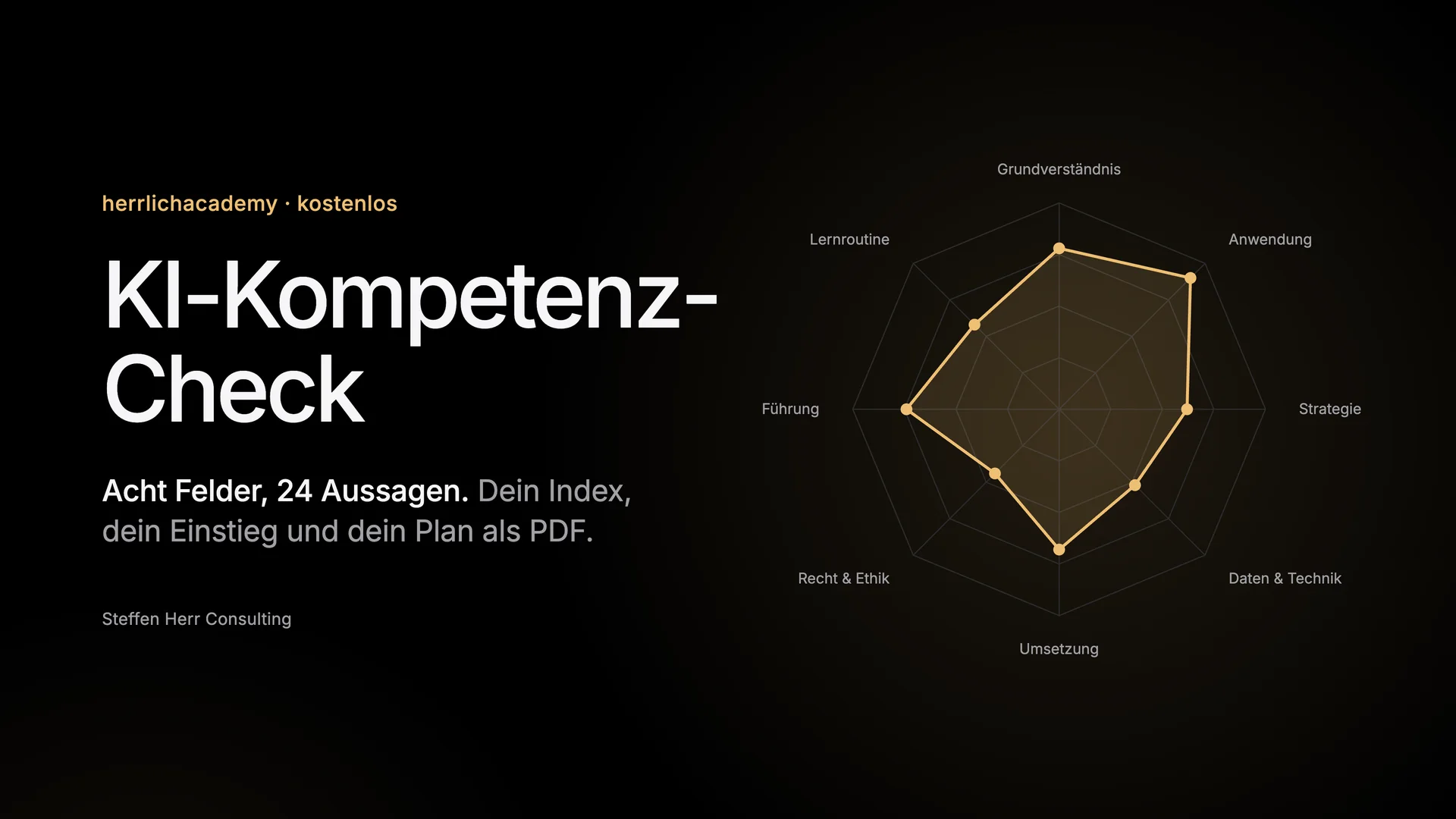
Die acht Felder der KI-Kompetenz
Die Grundlage ist ein Fragebogen aus meinem Kursmaterial mit sechs Bereichen und 18 Aussagen. Für den Check habe ich ihn auf acht Felder erweitert und jede Aussage so umgeschrieben, dass sie ein beobachtbares Verhalten beschreibt. „Ich verstehe die Bedeutung von Datenqualität“ lässt sich leicht bejahen. „Ich weiß, in welchen Systemen unsere wichtigsten Daten liegen“ zwingt zu einer ehrlichen Antwort.
- Grundverständnis. Wie ein Sprachmodell zu Antworten kommt und warum es überzeugend klingende Fehler macht.
- Praktische Anwendung. Ob du KI jede Woche für echte Aufgaben nutzt und gute Aufträge formulierst. Dieses Feld ist neu.
- Strategischer Blick. Wo KI in deinem Unternehmen messbar etwas verbessert und ob ihr kauft, anpasst oder selbst baut.
- Daten und Technik. Wo eure Daten liegen, wie gut sie sind und was ein Vorhaben technisch braucht.
- Projekte und Umsetzung. Ob du einen Pilot mit Ziel, Enddatum und Kennzahl aufsetzen kannst.
- Recht, Sicherheit und Ethik. Welche Daten in welches Werkzeug dürfen und was die EU-KI-Verordnung von euch verlangt.
- Führung und Wandel. Ob du Skeptiker mitnimmst und einen Lernplan für das Team aufstellen kannst.
- Lernroutine. Ob du eine feste Routine hast, um dranzubleiben. Auch dieses Feld ist neu, weil Wissen über KI schnell veraltet.
Was die EU-KI-Verordnung zur KI-Kompetenz verlangt
Artikel 4 der EU-KI-Verordnung gilt seit dem 2. Februar 2025. In der ersten Fassung mussten Anbieter und Betreiber von KI-Systemen ein ausreichendes Maß an KI-Kompetenz ihres Personals sicherstellen. Mit dem AI Omnibus, in Kraft seit dem 27. Juli 2026, wurde die Pflicht abgeschwächt. Unternehmen, die KI einsetzen, müssen jetzt Maßnahmen ergreifen, die die KI-Kompetenz ihrer Mitarbeitenden fördern. Ein bestimmtes Niveau müssen sie nicht garantieren.
Prüffrage: Könntest du heute aufschreiben, mit welchen Maßnahmen ihr die KI-Kompetenz im Team fördert? Eine Selbsteinschätzung je Person und ein Lernplan daraus sind ein nachvollziehbarer Anfang. Das ist eine Einordnung, keine Rechtsberatung.
Der Mini-Check: eine Minute, acht Aussagen
Bevor du den vollständigen Check machst, kannst du hier mit je einer Aussage pro Feld eine erste Richtung bekommen. Es wird nichts gespeichert.
Mini-Check · 8 Aussagen · 1 Minute
Wo stehst du gerade?
Grundverständnis Ich weiß, warum KI überzeugend klingende, aber falsche Aussagen macht.
1 trifft gar nicht zu · 5 trifft voll zu
Praktische Anwendung Ich nutze KI jede Woche für echte Arbeitsaufgaben.
Strategischer Blick Ich kann drei Abläufe nennen, in denen KI bei uns messbar hilft.
Daten & Technik Ich weiß, wo unsere wichtigsten Daten liegen und wie gut sie sind.
Projekte & Umsetzung Ich kann einen KI-Pilot mit Ziel, Enddatum und Kennzahl aufsetzen.
Recht, Sicherheit & Ethik Ich weiß, welche Daten ich in welches KI-Werkzeug eingeben darf.
Führung & Wandel Ich kann Skeptiker im Team für KI gewinnen.
Lernroutine Ich habe eine feste Routine, um bei KI auf dem Laufenden zu bleiben.
0 von 8 beantwortet.
Kurzform des KI-Kompetenz-Checks mit einer Aussage je Feld. Es wird nichts gespeichert.
So funktioniert der vollständige KI-Kompetenz-Check
Du beantwortest 24 Aussagen, drei je Feld, auf einer Skala von 1 bis 5. Dazu kommen drei kurze Angaben zu Rolle, Unternehmensgröße und wie oft du KI heute nutzt, damit die Empfehlungen zu dir passen. Direkt nach dem Absenden siehst du deinen KI-Kompetenzindex von 0 bis 100, den Wert jedes Feldes und das Feld, in dem du anfangen solltest. Für dieses Feld bekommst du drei konkrete Schritte für die nächsten 30 Tage.
| Index | Stufe | Was das heißt |
|---|---|---|
| 85 bis 100 | Vorreiter | Du nutzt KI sicher und bringst andere mit. |
| 70 bis 84 | Gestalter | Du setzt KI gezielt ein und kannst Vorhaben selbst anstoßen. |
| 50 bis 69 | Anwender | Du arbeitest mit KI, aber noch nicht in allen Feldern sicher. |
| 25 bis 49 | Entdecker | Du hast erste Erfahrungen, das Fundament ist noch lückenhaft. |
| 0 bis 24 | Einsteiger | Du stehst am Anfang, hier bringt ein klarer Plan am meisten. |
Der Einstieg ist immer das schwächste Feld. Bei Gleichstand gilt die Reihenfolge der Felder, das Grundverständnis zuerst. Liegt das Grundverständnis unter 40, weist die Auswertung darauf hin, auch wenn ein anderes Feld noch tiefer liegt, denn ohne dieses Fundament greifen die übrigen Schritte nicht. Deinen PDF-Bericht mit allen Antworten, den Feldwerten und den nächsten Schritten lädst du direkt herunter oder findest ihn später in deinem Konto unter „Meine Formulare“.
kostenlos · 6 Minuten
KI-Kompetenz-Check starten. 24 Aussagen, Auswertung sofort, persönlicher PDF-Bericht.
Die wichtigsten Inhalte gibt es auch als Folien, zum Beispiel für ein Teamtreffen: KI-Kompetenz-Check als Präsentation.
Was du mit deiner Auswertung anfängst
Nimm dir das Einstiegsfeld vor und nur dieses. Die drei Schritte sind so gewählt, dass sie in 30 Tagen machbar sind und ein Ergebnis hinterlassen, etwa eine einseitige KI-Leitlinie oder eine gemessene Zeitersparnis bei einer wiederkehrenden Aufgabe. Nach 90 Tagen machst du den Check noch einmal und vergleichst die Felder. Wenn du ein Team führst, lass jede Person den Check selbst machen. Der Vergleich zeigt, wer wem etwas beibringen kann.
der Kern in drei Sätzen
Fehlendes Wissen ist der häufigste Grund, warum Unternehmen KI nicht einführen, und die EU-KI-Verordnung verlangt Maßnahmen, die KI-Kompetenz fördern. Der KI-Kompetenz-Check zeigt in sechs Minuten, in welchem von acht Feldern dein größter Hebel liegt. Fang dort an, nur dort, und miss nach 90 Tagen erneut.
Häufige Fragen
Was ist KI-Kompetenz?
KI-Kompetenz ist die Fähigkeit, KI-Systeme sachkundig einzusetzen: zu verstehen, wie sie zu Ergebnissen kommen, sie im Alltag sinnvoll zu nutzen und Chancen, Risiken und mögliche Schäden einzuschätzen. Im Check ist sie in acht Felder geteilt, vom Grundverständnis bis zur Lernroutine.
Muss mein Unternehmen nach der EU-KI-Verordnung für KI-Kompetenz sorgen?
Ja, wenn es KI-Systeme einsetzt. Artikel 4 gilt seit dem 2. Februar 2025. Seit dem AI Omnibus vom 27. Juli 2026 verlangt er Maßnahmen, die die KI-Kompetenz der Mitarbeitenden fördern, statt ein bestimmtes Niveau sicherzustellen. Die Pflicht ist schwächer geworden, sie gilt aber weiter, auch für kleine Unternehmen. Das ist eine Einordnung, keine Rechtsberatung.
Wie lange dauert der KI-Kompetenz-Check und was kostet er?
Der Check ist kostenlos und dauert etwa sechs Minuten. Du beantwortest 24 Aussagen auf einer Skala von 1 bis 5. Die Auswertung siehst du direkt nach dem Absenden, den PDF-Bericht findest du zusätzlich in deinem Konto.
Ist eine Selbsteinschätzung aussagekräftig?
Sie misst, wie sicher du dich fühlst, nicht, was du in einer Prüfung leisten würdest. Genau das macht sie als Startpunkt nützlich: Sie zeigt das Feld, in dem du am unsichersten bist. Die Aussagen sind deshalb als konkretes Verhalten formuliert. Wenn du zögerst, nimm die niedrigere Zahl.
Kann ich den Check für mein ganzes Team nutzen?
Ja. Jede Person füllt den Check selbst aus und bekommt ihre eigene Auswertung. Im Erstgespräch können wir die Ergebnisse gemeinsam ansehen und daraus einen Lernplan für das Team ableiten.
Quellen und Stand
Stand: 18.10.2026, alle Quellen an diesem Tag abgerufen.
- Bitkom: Erstmals nutzt die Mehrheit der Unternehmen KI, 14.09.2026 (603 Unternehmen ab 20 Beschäftigten, befragt im Juli und August 2026).
- Statistisches Bundesamt: Gründe gegen die Nutzung von Technologien der künstlichen Intelligenz, Berichtsjahr 2025, Stand 24.11.2025.
- Europäische Kommission: AI Literacy, Questions and Answers (Artikel 4, Anwendung seit 02.02.2025).
- Europäische Kommission: AI Omnibus enters into force, 27.07.2026, sowie Verordnung (EU) 2026/1744.
Die acht Felder, die Aussagen, die Stufen und die Grafik zum Mini-Check sind eigene Darstellungen. Der Mini-Check ist eine Kurzform und keine Messung.